

Structured extraction
CVs and job ads are extracted into defined fields rather than summarised into prose, which is what makes the output checkable at all.
AI Orchestration & Compliance
The question a search firm should ask about AI is not whether it is impressive but whether its output can be defended six months later. RayCruit treats AI as a governed capability: every output checked, every call logged, every downstream artefact aware of when its source changed.
The problem
A recruiter pasting a CV into a chat window gets a useful summary and creates four problems: nobody knows which model produced it, nobody can reproduce it, it silently overwrote the recruiter's own judgement, and when the CV is updated the summary stays wrong. In a regulated, client-facing business, that is not a productivity gain.
AI in RayCruit is confined to well-defined actions with defined inputs and outputs in a fixed structure. That constraint is what makes it auditable.
CVs and job ads are extracted into defined fields rather than summarised into prose, which is what makes the output checkable at all.
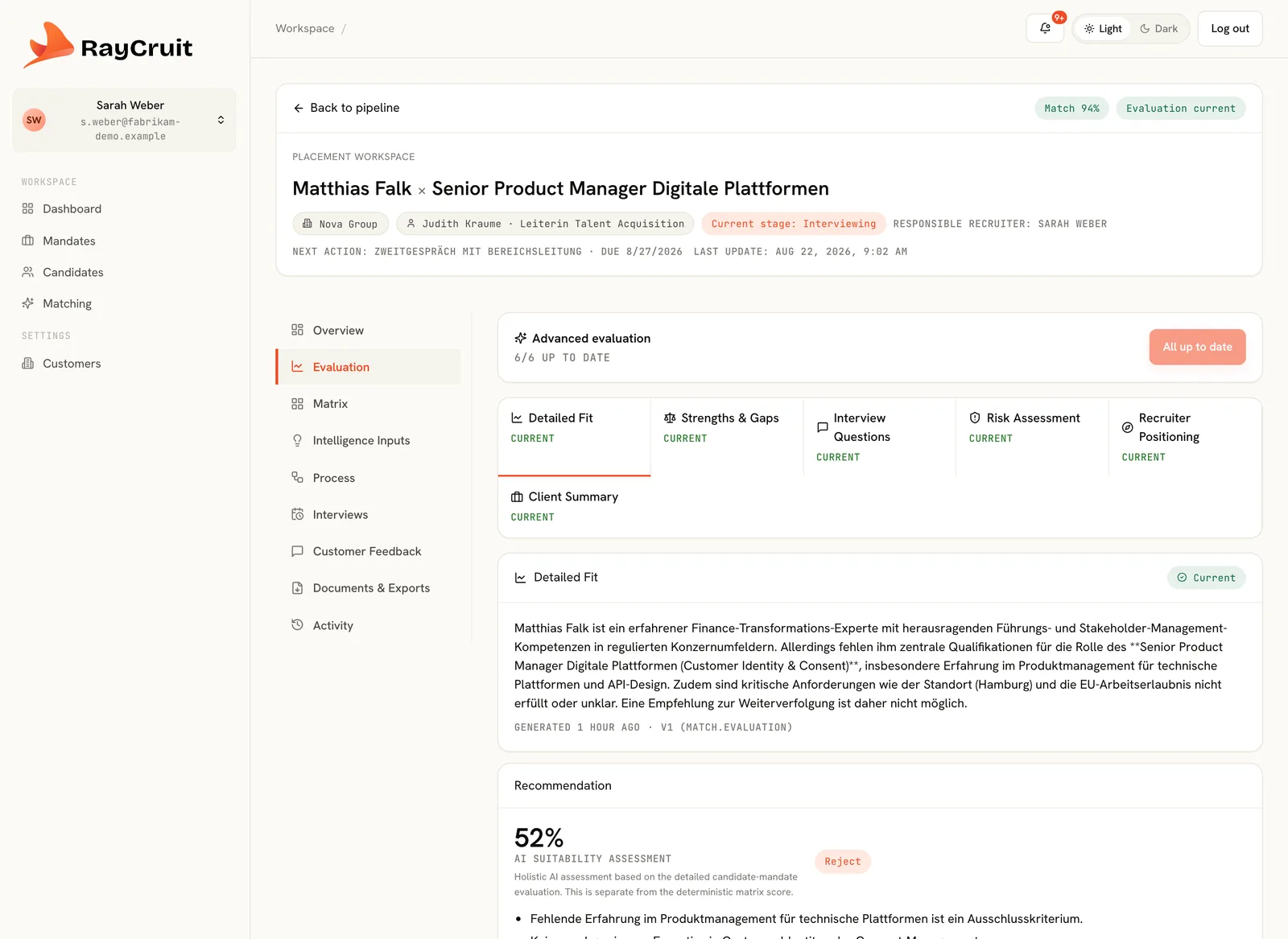
Every AI output is checked against a fixed structure before it reaches a recruiter's screen. Anything that does not fit is not displayed.
Prompts are versioned artefacts. Any past output can be traced to the exact prompt version that produced it.
Every call records its provider, model, prompt version, input and output — and can be streamed live so administrators can watch the system work.
Change a CV or a mandate and every dependent analysis, matrix and export flags itself for regeneration. No client receives a summary built on an outdated source.
AI fills blanks and proposes changes. It does not overwrite what a human wrote, and every suggestion is visibly a suggestion until accepted.
AI output is decision-support material. The workflow requires a person between generation and anything client-facing.
RayCruit supports OpenAI, Anthropic, Google and Mistral, and any individual AI action can be routed to a different provider without a redeploy. The managed RayCruit service currently processes with Mistral AI in Europe — see the Privacy Policy for the current subprocessors.
The core match score is computed, not generated. AI is used for judgement-shaped tasks — risk, positioning, interview preparation — not for the number the shortlist is ranked on.
Every AI action in the platform follows the same governed path.
A recruiter runs a specific action against specific structured input.
The action uses a versioned prompt routed to the configured provider and model.
The response is checked against the expected structure before it is accepted.
The output is presented as a suggestion for a person to accept, edit or discard.
If the source later changes, everything derived from it is flagged for regeneration.
An enterprise client asking which models process their candidate data gets a specific, configurable answer.
A firm that requires a particular provider for certain data routes those actions accordingly, without changing anything else.
When a client questions a claim in a submission, the logged prompt version and inputs make the answer reconstructable.
Governance answers the questions procurement and legal actually ask.
Dependency tracking prevents the most damaging category of error.
Human judgement stays authoritative by design, not by convention.
See it in motion
How the modules hand over to each other in the real product — customer and mandate, candidate and matrix, the workspace where a pairing is decided, and the material that goes to the client.
2 min
Continue across the platform
Rule-based scoring across 12 dimensions and 90 criteria, with evidence on every line.
Learn morePermission groups, confidential mandates, enterprise sign-in and an append-only audit trail.
Learn moreStructured CVs, skills, languages, eligibility and a reusable candidate matrix.
Learn moreA demo follows one mandate across every module, which is the only way the connections become obvious.