

The platform

The operating platform for search firms.

CRM, mandates, candidates, matching, documents, portals and governed AI — built into one placement workflow, on one shared set of records, with one permission system.

Platform map

The same records underneath every module.

The reason placement work fragments is that each tool owns its own copy of the truth. RayCruit is built the other way round: customers, mandates, candidates and their pairings are shared objects, and every module — matching, documents, portals, reporting, audit — reads from and writes back to the same records.

Record layer
Customers, contacts and contact rolesMandates with requirements, gates and commercial termsCandidates with structured CVs, skills, languages and eligibilityCandidate × mandate placements as their own objectDocuments, notes, activities and interviews
Intelligence layer
Rule-based matching across 12 dimensions and 90 criteriaHard requirements evaluated as gates before any scoringCandidate matrix and mandate matrix maintained separatelyAI extraction from CVs and job ads, checked against a fixed structureAI analyses for risk, positioning and interview preparation
Delivery layer
Anonymised CVs, full CVs and candidate descriptionsFit explanations and executive summariesShortlist material and client booklets as PDF or DOCXWhite-label candidate and customer portalsTenant branding, cover pages and export naming
Governance layer
Role-based permission groups: who may view, create, edit and delete each record typeSix purpose-built roles from Owner to Read-onlyPer-mandate access lists for confidential searchesOIDC single sign-on, provisioning and enforced two-factorBusiness activity timeline and append-only security log

Record layer

The objects a search firm actually works with, modelled as first-class records rather than fields bolted onto a generic CRM.

  • Customers, contacts and contact roles
  • Mandates with requirements, gates and commercial terms
  • Candidates with structured CVs, skills, languages and eligibility
  • Candidate × mandate placements as their own object
  • Documents, notes, activities and interviews

Intelligence layer

The structured reasoning that turns records into decisions — rule-based where the result must be repeatable, AI-assisted where judgement genuinely helps.

  • Rule-based matching across 12 dimensions and 90 criteria
  • Hard requirements evaluated as gates before any scoring
  • Candidate matrix and mandate matrix maintained separately
  • AI extraction from CVs and job ads, checked against a fixed structure
  • AI analyses for risk, positioning and interview preparation

Delivery layer

Everything that leaves the building — under your brand, generated from work already done, and traceable back to the evaluation behind it.

  • Anonymised CVs, full CVs and candidate descriptions
  • Fit explanations and executive summaries
  • Shortlist material and client booklets as PDF or DOCX
  • White-label candidate and customer portals
  • Tenant branding, cover pages and export naming

Governance layer

The controls that make a shared talent pool and confidential searches coexist in one tenant without leaking either.

  • Role-based permission groups: who may view, create, edit and delete each record type
  • Six purpose-built roles from Owner to Read-only
  • Per-mandate access lists for confidential searches
  • OIDC single sign-on, provisioning and enforced two-factor
  • Business activity timeline and append-only security log

Placement workflow

From intake to placement to what you bill, without leaving the platform.

Each step produces the structured data the next step needs. Nothing has to be re-keyed, and nothing depends on the recruiter who started the search still being the one who finishes it.

  1. 01Win the mandate
  2. 02Structure the brief
  3. 03Source and shortlist
  4. 04Evaluate
  5. 05Deliver
  6. 06Track and close
  7. 07Bill what was agreed
  1. 01

    Win the mandate

    Capture the client, the stakeholders, the commercial model — success fee, retainer, fixed, hourly or subscription — and the full search brief in one intake.

  2. 02

    Structure the brief

    Attach the job ad and let extraction structure role details, requirements and search criteria. Mark the must-haves that should act as gates and the rest as weighted criteria.

  3. 03

    Source and shortlist

    Pull candidates from the shared tenant pool into a per-mandate pipeline and move them through new, longlist and shortlist as evidence accumulates.

  4. 04

    Evaluate

    Open the Placement Workspace for each pairing: run the matrix, add recruiter intelligence, review gates, then decide with the evidence visible.

  5. 05

    Deliver

    Generate the anonymised CV, the fit explanation and the shortlist booklet on your brand, and submit them to the client.

  6. 06

    Track and close

    Follow the client-side outcome from viewed to interviewing to hired, capture feedback against the pairing, and keep the reasoning for the next search.

  7. 07

    Bill what was agreed

    The events the search produced — submission, interview, offer, start — are proposed against the mandate's commercial terms, so whoever raises the invoice starts from confirmed facts rather than from memory.

Core objects

What RayCruit models that a generic ATS does not.

The difference between an applicant tracking system and a placement platform is what it treats as a first-class object. These are the ones that matter for search work.

Placement workspace
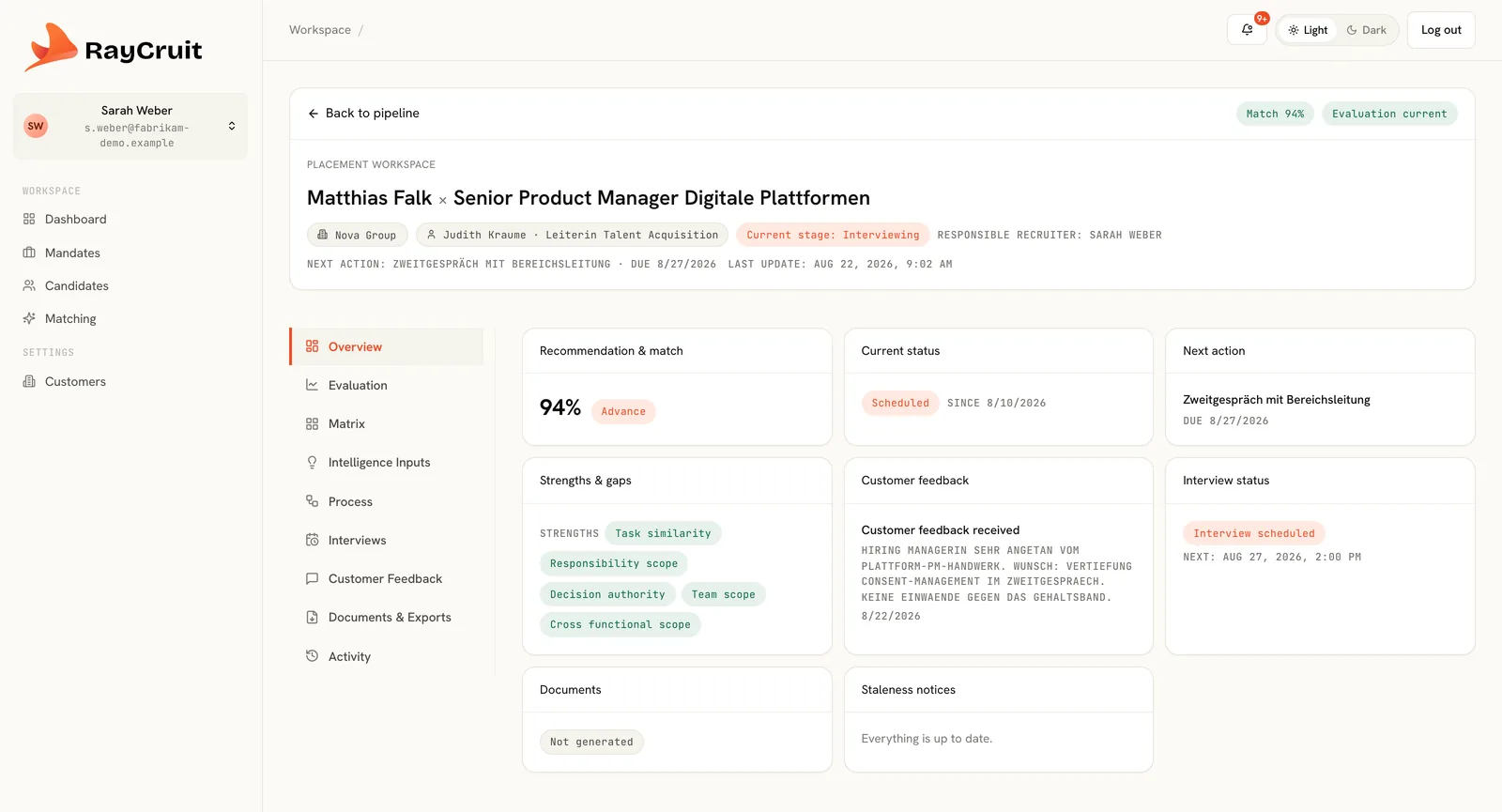
Placement Workspace for one candidate paired with one mandate: match 94 percent, current status, next action, strengths and gaps, client feedback and interview status.
01

The mandate, not the job posting

A mandate carries commercial terms, stakeholder map, confidentiality, gates and weighted criteria — the things that decide whether the search is profitable, not just whether it is open.

02

The placement pairing

Candidate × mandate is where evaluation, interviews, client feedback and delivered documents live. Store it properly and the reasoning survives staff turnover.

03

Two separate matrices

Candidate intelligence and mandate intelligence are maintained independently, so a candidate assessed once can be compared against every open search without re-reading the CV.

04

The client relationship

Contacts carry roles, mandates carry their own contact set, and account-level history stays attached across every search you have run for that client.

05

The delivered artefact

A generated document knows which profile version and which evaluation produced it — which is what makes staleness detection possible at all.

06

The audit event

Business activity and security events are kept apart, so a partner reviewing delivery health and an auditor reviewing access are not reading the same feed.

Why it holds up

Four decisions that shape the whole platform.

Rules first, AI second

The core match score is computed, not generated. It is reproducible, inspectable and consistent across every candidate in a shortlist — which is what makes it usable in a client conversation.

Gates before averages

A hard requirement such as work authorisation is evaluated as a gate before scoring begins. A dealbreaker is never smoothed into an acceptable percentage.

Structure before generation

Documents are generated from structured records and a completed evaluation, so client-facing output reflects the work rather than reproducing a prompt.

Governance before scale

Permission groups, per-mandate access lists and an append-only audit trail exist because confidential search and a shared talent pool have to live in the same tenant.

See it in motion

The platform, end to end, in two minutes.

How the modules hand over to each other in the real product — customer and mandate, candidate and matrix, the workspace where a pairing is decided, and the material that goes to the client.

2 min

Walk the platform on one of your own searches.

Bring a live or recently completed mandate. We map it end to end, and you see what the structured version of your own process looks like.