

Job ad upload and extraction
Attach the job ad and let structured extraction populate role details, requirements and search criteria — then correct anything it got wrong before it becomes the brief.
Mandate Management
A search brief captured as prose is a search brief nobody can filter, compare or hand over. RayCruit turns the mandate into structured requirements — with must-haves marked as gates and everything else weighted — so the rest of the platform has something precise to work with.
The problem
The important parts of a mandate — the requirement that is genuinely non-negotiable, the reason the last hire failed, the salary band the client will actually approve — are discussed once and then survive only as notes. By the third week, the shortlist is being built against a version of the brief that exists only in one recruiter's memory.
The mandate is the specification for everything downstream. RayCruit structures it once, at intake, and every module reads from that structure rather than re-interpreting the brief.
Attach the job ad and let structured extraction populate role details, requirements and search criteria — then correct anything it got wrong before it becomes the brief.
Requirements are explicitly separated. Must-haves become gates evaluated before scoring; nice-to-haves become weighted criteria that shape ranking without blocking anyone.
The structured requirement set the matching engine compares candidates against — maintained on the mandate side, independent of any individual candidate.
The client-side contact set for this specific search, with roles, drawn from the account record.
Success fee, retainer, fixed, hourly or subscription — recorded on the mandate so delivery and profitability are discussed with the same figures.
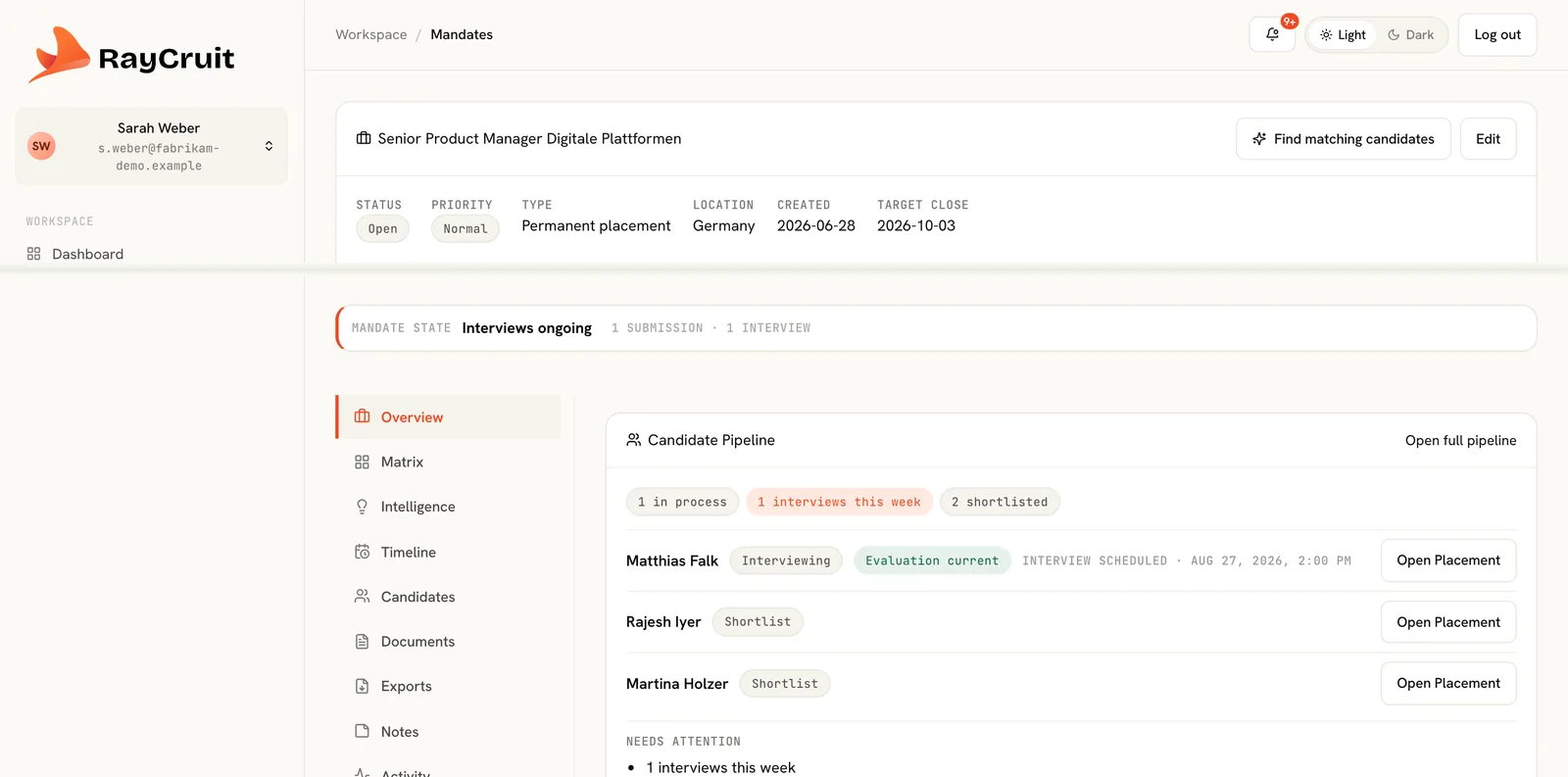
Candidates move through new, longlist and shortlist, with the mandate overview surfacing what needs a decision today.
The goal of intake is not to record the conversation. It is to leave behind a specification the platform can act on.
Attach it to the client account and pull in the relevant stakeholders.
Upload or paste it and run extraction to populate the structured fields.
Mark the genuine must-haves as gates and weight the remaining criteria.
Record the fee model, the timeline and the confidentiality level of the search.
Add candidates from the pool and let the matrix rank them against the structured brief.
A sensitive mandate carries its own access list, so only the assigned team sees the client, the role and the pipeline.
Three regional versions of the same role share a requirement structure but keep separate pipelines, stakeholders and commercial terms.
A mandate that reopens six months later starts from the structured brief and the candidates already assessed against it.
Extraction handles the transcription so the recruiter spends the time on judgement.
A structured brief is what makes a shortlist genuinely comparable rather than a list of opinions.
Any recruiter can pick up the mandate and see the same specification.
See it in motion
How the modules hand over to each other in the real product — customer and mandate, candidate and matrix, the workspace where a pairing is decided, and the material that goes to the client.
2 min
Continue across the platform
Client companies, contacts, roles and the relationship history behind every mandate.
Learn moreRule-based scoring across 12 dimensions and 90 criteria, with evidence on every line.
Learn moreThe candidate × mandate workbench for evaluation, process, feedback and delivery.
Learn moreA demo follows one mandate across every module, which is the only way the connections become obvious.