

Anonymised CV
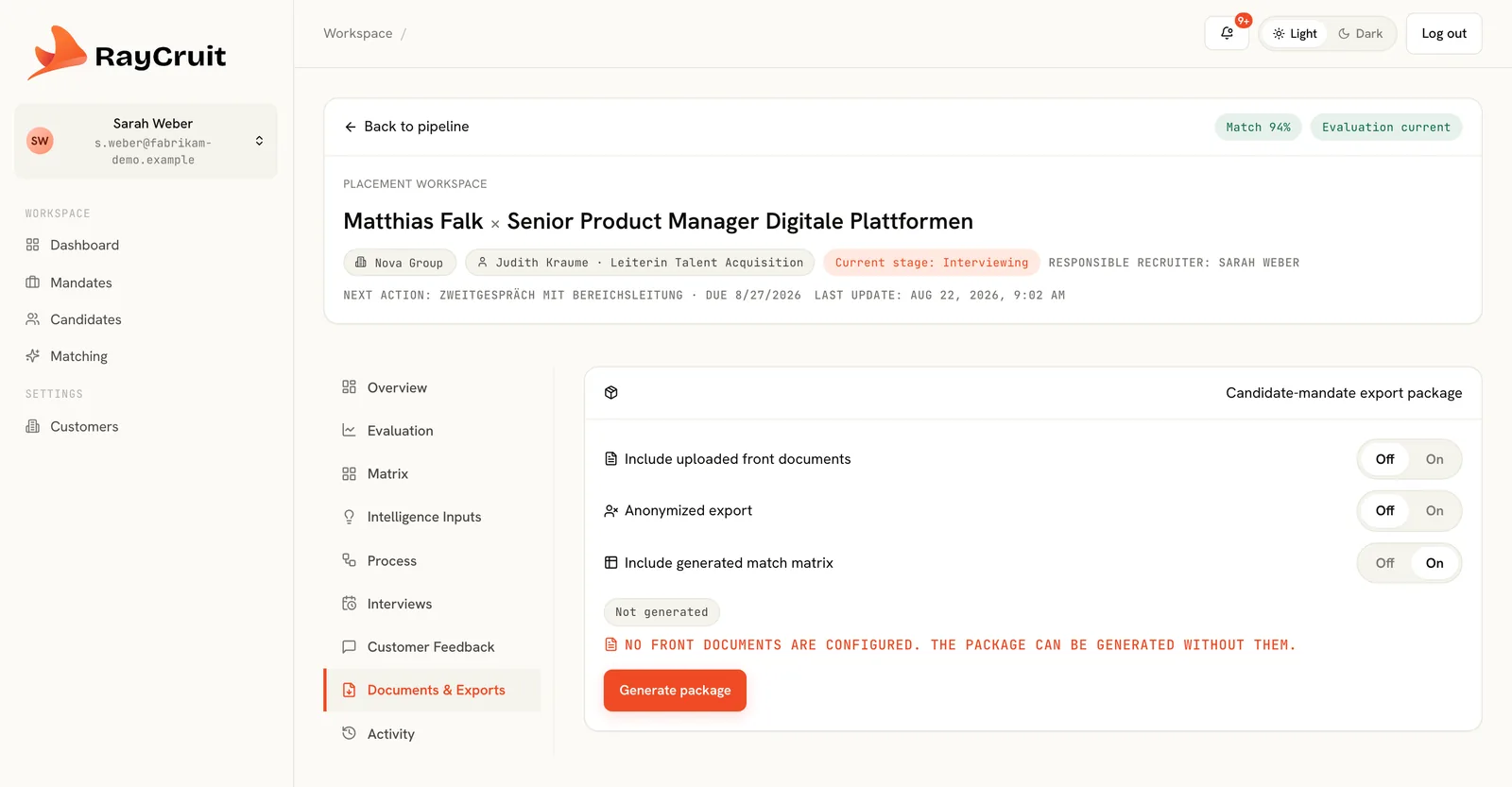
Employer names, contact details and identifying markers removed systematically rather than by hand, so the same rules apply to every profile every time.
Documents & Exports
Reformatting a CV into house style, blanking the employer names, writing the fit summary and assembling the booklet is the part of placement work that consumes afternoons and produces no new thinking. RayCruit generates all of it from the structured profile and the completed evaluation, on your firm's brand.
The problem
Everything the client judges you on is assembled by hand, usually under time pressure, usually by the most experienced person available. It is also the step where mistakes are most expensive: an old CV version, a client name left in an anonymised profile, inconsistent formatting across a shortlist that was built by three different recruiters.
Because the candidate record and the evaluation are structured, the documents are a rendering problem rather than a writing problem. The firm's format is applied once and every export follows it.
Employer names, contact details and identifying markers removed systematically rather than by hand, so the same rules apply to every profile every time.
The complete structured CV in your firm's format, generated from the same record as the anonymised version so the two cannot diverge.
The narrative profile a client reads first, generated from structured experience rather than rewritten per mandate.
The match matrix rendered as a client-readable explanation of why this candidate suits this mandate — criterion by criterion, with the evidence.
A whole shortlist assembled into one consistently formatted document, with cover page and per-candidate sections.
Tenant branding, cover backgrounds and file-name prefixes applied automatically, in the format the client expects to receive.
Original CVs, certificates and supporting files stored against the candidate, with download rights controlled by permission group.
If the underlying CV or evaluation changes, dependent exports flag themselves for regeneration — so an outdated summary does not reach a client.
The generation step sits at the end of work already completed, which is why it takes minutes rather than an afternoon.
The matrix and recruiter assessment provide the substance the documents are built from.
Anonymised CV, full CV, candidate description, fit explanation — individually or as a shortlist booklet.
Tenant branding, cover page and naming conventions are applied automatically.
Generated output is reviewed like any other AI-assisted artefact, never sent blind.
The submission is recorded against the pairing and the client-side outcome is tracked from there.
A shortlist of six arrives at the client in consistent house format on the day it was agreed, not two days later.
Anonymised profiles let a client assess a senior candidate before any identity is disclosed.
Every office produces identical client-facing formatting because the format lives in the platform, not in a template someone copied.
Document assembly stops being the bottleneck between decision and delivery.
Systematic redaction removes the most damaging manual error in the process.
Every client sees the same quality regardless of who prepared the submission.
See it in motion
How the modules hand over to each other in the real product — customer and mandate, candidate and matrix, the workspace where a pairing is decided, and the material that goes to the client.
2 min
Continue across the platform
The candidate × mandate workbench for evaluation, process, feedback and delivery.
Learn moreRule-based scoring across 12 dimensions and 90 criteria, with evidence on every line.
Learn moreBranded, invitation-only access for named client contacts — no shared logins, no attachments.
Learn moreA demo follows one mandate across every module, which is the only way the connections become obvious.