

CV upload and structured extraction
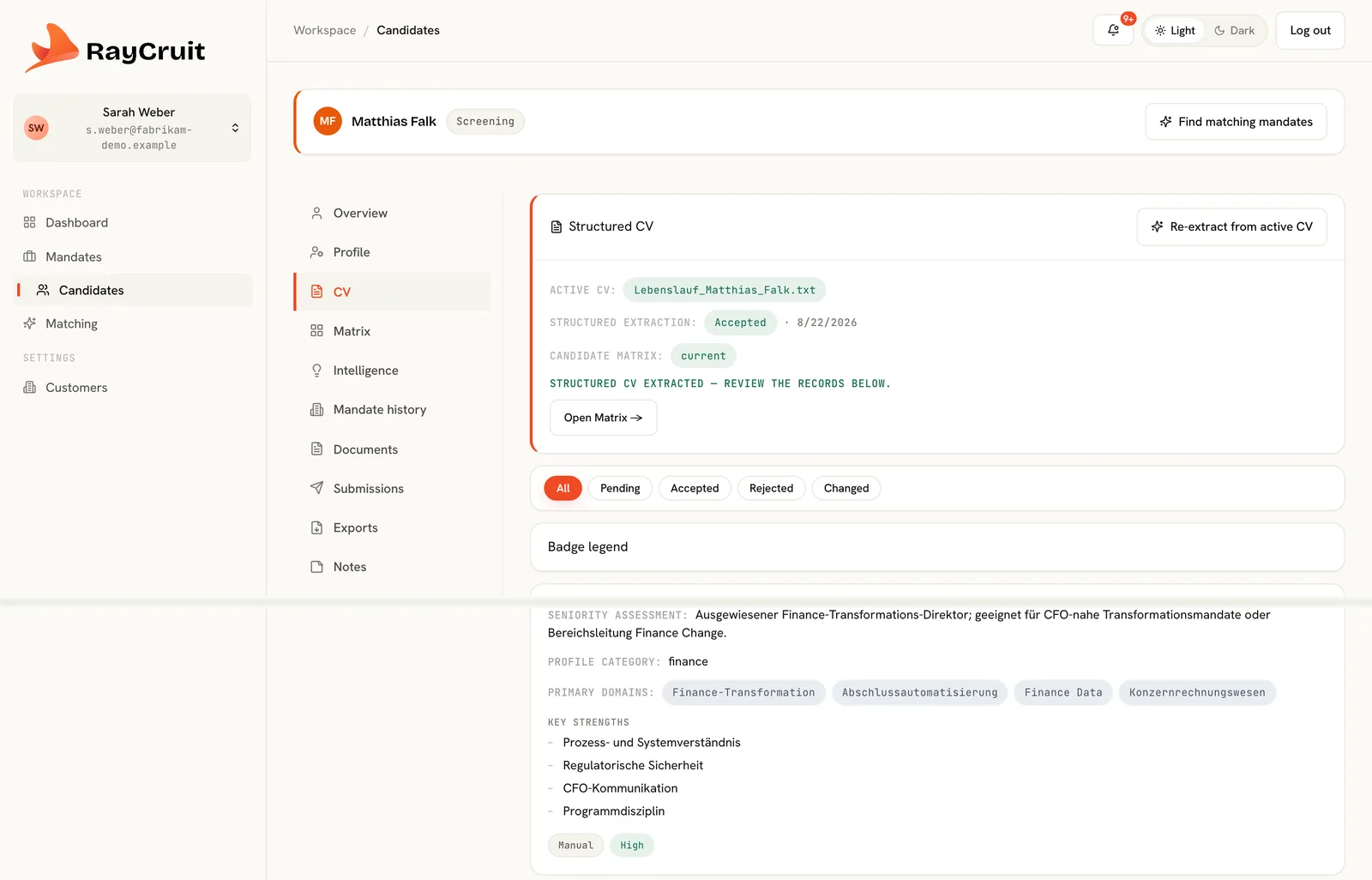
Upload a CV and extraction produces a professional summary, work experience, skills, languages and certifications — every field checked against a fixed structure before a recruiter sees it.
Candidate Intelligence
A CV read by a recruiter produces an assessment that lasts as long as their memory of it. RayCruit turns the same reading into structured candidate intelligence — a profile the whole firm can search, compare against any mandate and present to a client without opening the original file again.
The problem
Most agencies hold thousands of CVs and can search almost none of them meaningfully. The documents are stored, but the understanding — this person has genuine P&L responsibility, this one's German is conversational not fluent, this one cannot work in the EU without sponsorship — was never captured as anything a query could reach.
Extraction produces the structure; the recruiter confirms it; the platform reuses it. From that point the candidate is a queryable, comparable, presentable record rather than an attachment.
Upload a CV and extraction produces a professional summary, work experience, skills, languages and certifications — every field checked against a fixed structure before a recruiter sees it.
Roles, employers, dates, scope and responsibilities become structured entries, which is what makes seniority and domain exposure comparable across candidates.
Classified skills and language proficiencies stored as data, so 'fluent German, conversational French' is a filter rather than a sentence in a summary.
Availability, notice period and work authorisation captured explicitly — these are the fields that most often need to act as hard gates.
The candidate-side intelligence maintained independently of any mandate, so one assessment serves every open search rather than being redone per role.
Extraction fills blanks and proposes improvements. It never overwrites what a human wrote, and every suggestion is visible as a suggestion.
The work happens once, at the point the candidate enters the pool.
Create the record and upload the CV and any supporting documents.
Structured extraction populates summary, experience, skills, languages and certifications.
The recruiter confirms or edits. Human edits are authoritative from that point on.
Availability, notice period and work authorisation — the fields that gate mandates.
The finished profile is immediately comparable against every open search in the tenant.
A mandate opens and the existing pool is searched on structured criteria rather than starting a fresh sourcing cycle from zero.
A sourcer builds structured profiles and a recruiter consumes them, without a handover conversation for every candidate.
Work authorisation and certification requirements are recorded as fields, so they can gate a mandate instead of being spotted late.
The CV is read once properly, not partially for every mandate it might suit.
Structured fields make the existing database an asset rather than an archive.
Every candidate is described against the same structure, which is what makes comparison fair.
See it in motion
How the modules hand over to each other in the real product — customer and mandate, candidate and matrix, the workspace where a pairing is decided, and the material that goes to the client.
2 min
Continue across the platform
Rule-based scoring across 12 dimensions and 90 criteria, with evidence on every line.
Learn moreAnonymised CVs, fit explanations, executive summaries and client booklets on your brand.
Learn moreA white-label portal where candidates keep their own details current — and you approve every change.
Learn moreA demo follows one mandate across every module, which is the only way the connections become obvious.