

Small pipelines, high stakes
Six candidates, not six hundred. Every profile is examined in detail and every rejection needs a reason.
Executive Search
Executive search runs long, involves few candidates and ends in a conversation where the client expects you to justify the recommendation. The two things that make it hard — confidentiality and the depth of assessment required — are exactly the things that push search firms back into spreadsheets.
Six candidates, not six hundred. Every profile is examined in detail and every rejection needs a reason.
The client, the role and sometimes the existence of the search cannot be visible tenant-wide.
Months between briefing and placement, often outlasting the memory of the people involved.
Multiple client-side stakeholders review the same shortlist and need to reach agreement.
When permissions cannot express 'this mandate, these three people', sensitive searches move to private documents — and lose every benefit of the platform.
Weeks of assessment produce a recommendation that exists as a conversation and a Word document, and cannot inform the next search.
The client asks why this candidate over that one, and the answer is assembled on the spot from memory.
Four stakeholders reply by email in four directions, and reconciling them falls to the recruiter.
Executive search is the use case that most demands both governance and explainability — which are the two things the platform is built around.
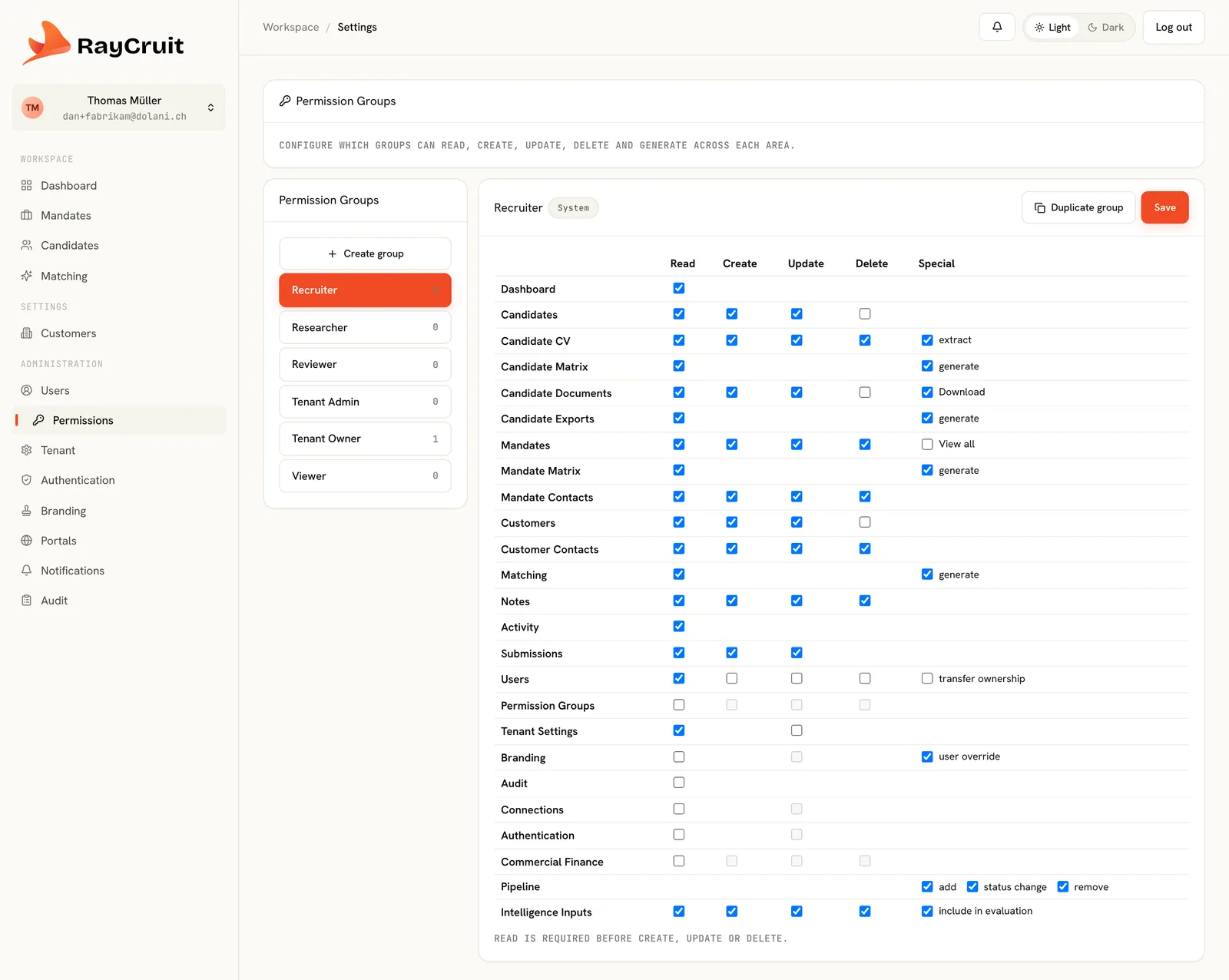
A per-mandate access list keeps the search inside the assigned team while remaining in the governed platform.
Non-negotiables become gates; the nuanced requirements become weighted criteria.
Each pairing gets evaluation, matrix, interviews and feedback in one place that survives the length of the search.
Senior candidates are assessed by the client before any identity is disclosed.
The fit explanation gives the committee a criterion-level basis for discussion instead of an impression.
No mandate has to leave the platform to stay discreet.
The justification is documented as the assessment happens, not reconstructed afterwards.
Feedback recorded against the pairing replaces four email threads.
Continue across the platform
Permission groups, confidential mandates, enterprise sign-in and an append-only audit trail.
Learn moreRule-based scoring across 12 dimensions and 90 criteria, with evidence on every line.
Learn moreThe candidate × mandate workbench for evaluation, process, feedback and delivery.
Learn moreAnonymised CVs, fit explanations, executive summaries and client booklets on your brand.
Learn moreThe demo is more useful when it follows your process rather than a generic one. Bring a live mandate and we will map it.