

Candidate matrix and mandate matrix
Candidate evidence and mandate requirements are structured independently, so neither is distorted by the other and both are reusable.
Matching & Matrices
Most AI matching is a black box with a percentage on it — impossible to defend when a client asks why candidate three ranked above candidate one. RayCruit's core score is computed by fixed rules across 12 dimensions and 90 criteria — not by a language model: reproducible, inspectable and identical every time you run it.
The problem
Opaque matching creates a specific failure: the recruiter cannot tell whether an 82% means a strong candidate with one gap or a mediocre candidate with no disqualifiers. Worse, a hard requirement — the right to work in the country, a mandatory licence — gets averaged in with everything else, so a candidate who cannot legally take the job still scores respectably.
RayCruit maintains candidate intelligence and mandate intelligence separately, then compares them. Separating the two is what allows one candidate assessment to serve every open mandate — and what makes the comparison auditable.
Candidate evidence and mandate requirements are structured independently, so neither is distorted by the other and both are reusable.
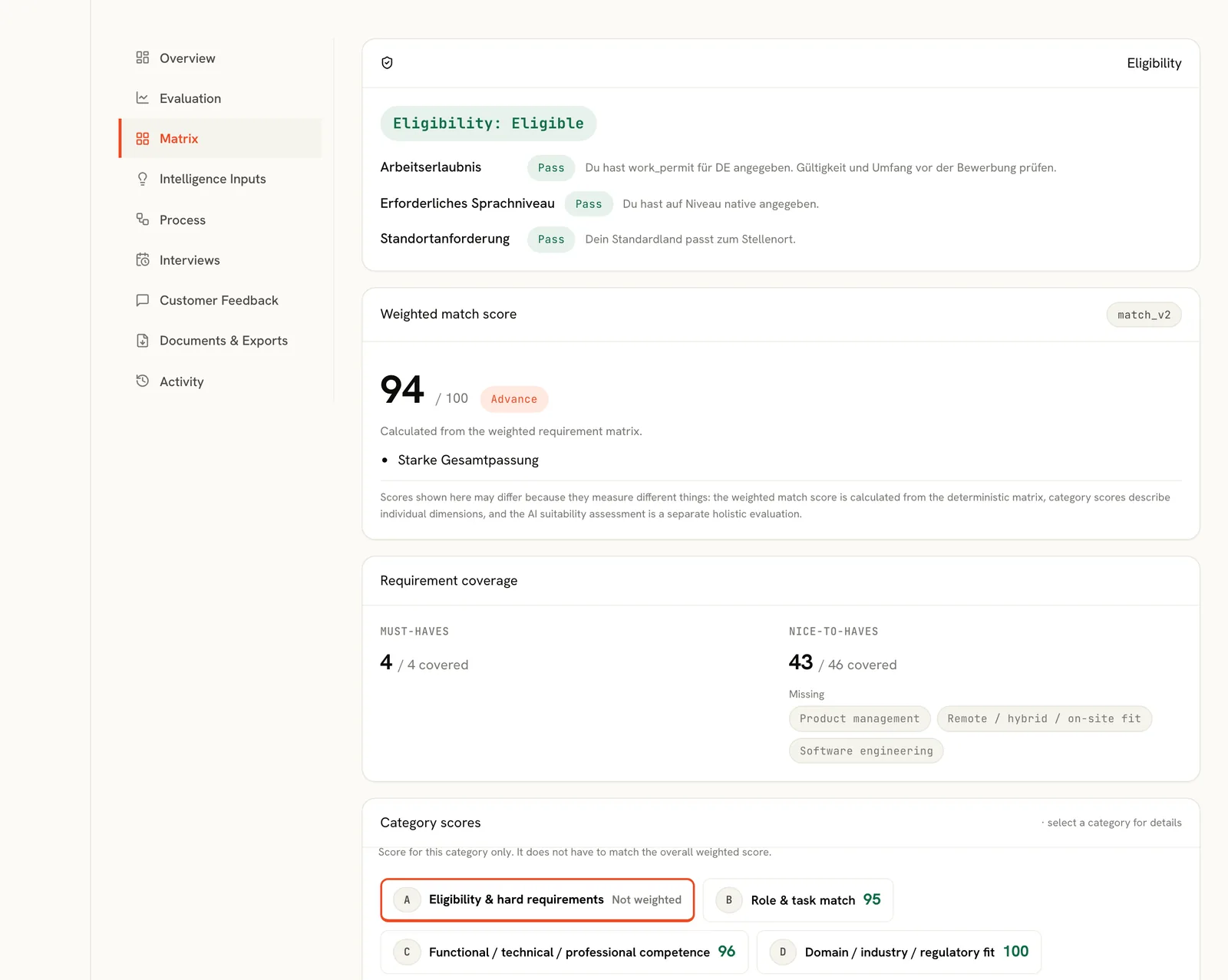
The core score is computed across 12 dimensions and 90 criteria. The same inputs always produce the same output — which is what makes it comparable across a shortlist.
Hard requirements such as work authorisation are evaluated as gates before any scoring happens. A failed gate is a failed gate, not a lower average.
Each line shows the mandate's requirement, the candidate's value, the score and a readable reason — so the ranking can be inspected line by line.
When a mandate never stated a requirement, the matrix says so rather than penalising a candidate for failing to satisfy something nobody asked for.
Change the CV or the mandate and the matrix flags itself for regeneration, so a shortlist is never ranked on last month's information.
Where genuine judgement helps rather than computation, dedicated analyses cover risk, positioning and interview preparation — each grounded in the structured facts.
Nothing in the sequence is hidden, and every step is inspectable afterwards.
The candidate matrix and the mandate matrix are built from validated structured data.
Hard requirements are checked first. A failure is reported as a failure, not folded into a score.
Remaining criteria are scored across the 12 dimensions, each with its evidence and confidence.
The recruiter reads criterion by criterion, and adds judgement where the data cannot decide.
The same structure becomes the fit explanation that goes out with the submission.
Forty candidates ranked consistently against the same structured brief, with the reasoning attached to each position.
When a client asks why a candidate was included, the answer is a criterion-level comparison rather than a recruiter's impression.
A strong candidate failing a single gate is visible immediately, which turns a rejection into a solvable question.
Client conversations move from assertion to evidence.
Consistent scoring removes the slowest, least reliable part of manual comparison.
Determinism means the team can rely on the score instead of second-guessing it.
See it in motion
How the modules hand over to each other in the real product — customer and mandate, candidate and matrix, the workspace where a pairing is decided, and the material that goes to the client.
2 min
Continue across the platform
Structured CVs, skills, languages, eligibility and a reusable candidate matrix.
Learn moreThe candidate × mandate workbench for evaluation, process, feedback and delivery.
Learn moreEvery output checked against a fixed structure, versioned prompts, provider logging and staleness control.
Learn moreA demo follows one mandate across every module, which is the only way the connections become obvious.