

Hiring managers as clients
Each search has an internal stakeholder with their own expectations and availability.
In-house Search Teams
Internal search teams face the same structural issue as an agency: a brief agreed verbally, requirements that shift, and a shortlist that has to be justified to someone who was not part of the assessment. The difference is that the client sits two floors up and can change their mind on Thursday.
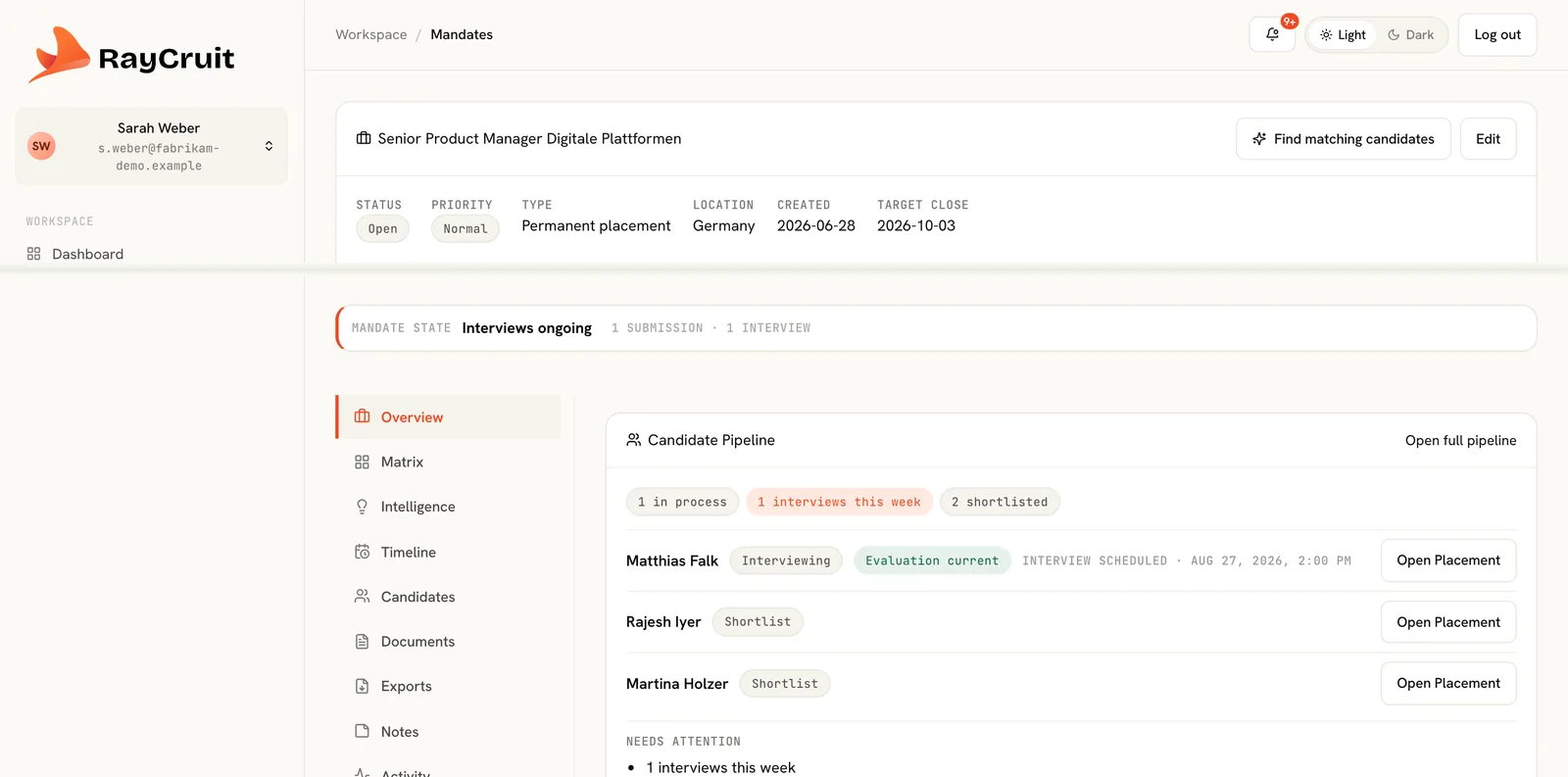
Each search has an internal stakeholder with their own expectations and availability.
Senior and specialised roles handled as structured searches rather than as an application funnel.
Briefs evolve as the organisation's needs change mid-search.
Shortlist decisions are reviewed by people who need to understand the reasoning.
A corridor conversation becomes the specification, and three weeks later nobody agrees on what was asked for.
The role changes but the change is never recorded, so earlier candidates were assessed against a brief that no longer applies.
A hiring manager asks why a candidate was excluded and the answer is not documented.
ATS tools model an application funnel, not a search with requirements, gates and active sourcing.
The platform gives internal teams the same structure agencies use, with the hiring manager in the client role.
The hiring manager's brief becomes a structured mandate with explicit must-haves.
Non-negotiables are agreed and recorded before sourcing begins, not discovered at offer stage.
Every candidate is compared against the same structured requirements.
The hiring manager reviews the shortlist material and their feedback is recorded against the pairing it belongs to.
Inclusion and exclusion decisions are recorded as they are made.
A structured mandate is harder to reinterpret than a conversation.
Shortlist reasoning is documented and reviewable.
Hiring managers self-serve status rather than interrupting the team.
Continue across the platform
Structured search briefs with requirements, gates, commercials and a live pipeline.
Learn moreRule-based scoring across 12 dimensions and 90 criteria, with evidence on every line.
Learn moreBranded, invitation-only access for named client contacts — no shared logins, no attachments.
Learn moreThe candidate × mandate workbench for evaluation, process, feedback and delivery.
Learn moreThe demo is more useful when it follows your process rather than a generic one. Bring a live mandate and we will map it.